

The leadership offsite went well. Now what?
You were in the room when the business targets were set and it all felt ambitious but achievable. Then you walk back to your team, where the work lives across Jira, Asana, a sales spreadsheet and a WIP doc for every function, and you know a two-line Slack from the CEO on Sunday could reshuffle it all.
A month in, there are new campaigns, journey fixes, an urgent favour for sales and an idea someone senior has mentioned twice. None of it is stupid, so nothing gets cut, and the work that matters gets pushed. Again.
FIRM Planning is the glue between the goals set upstairs and the work your team actually does, so they can stay focused on achieving them.
Built for marketing and CX teams. Not borrowed from engineering.
It sits between your OKRs and your project tools. It’s where the team decides what it will do and why, tracks what it actually does, and measures the value of what got done, all on one visual board.
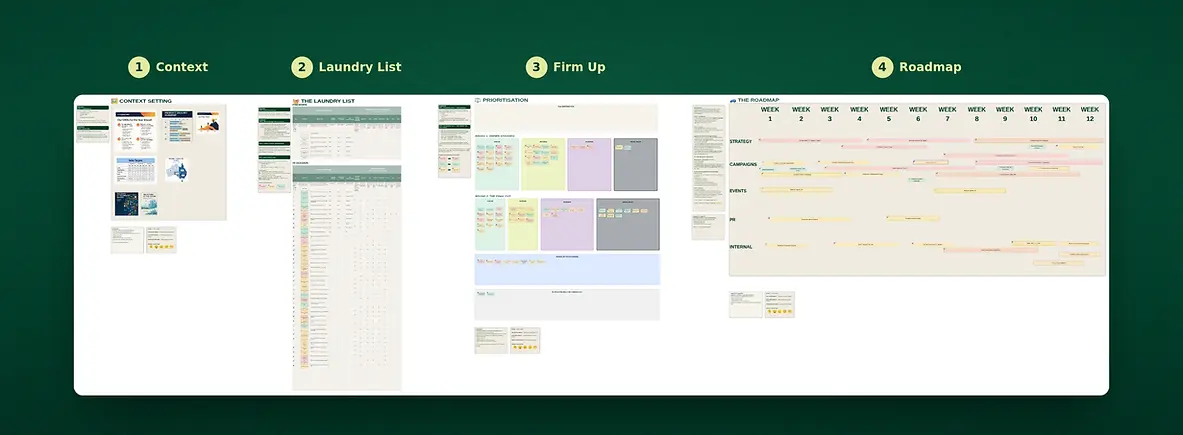
1. Context. The targets and what’s shifted go up first, so every call after that gets made against the same goals.
2. Laundry List. Everything competing for the team’s time goes on the board, including the “quick favours” nobody signed off. It’ll be longer than your capacity.
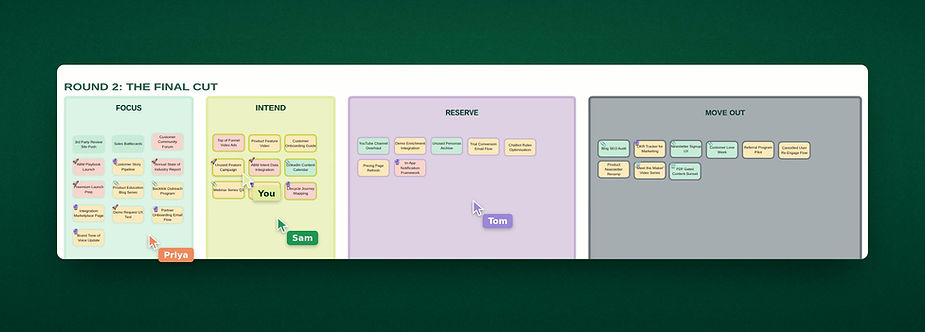
3. Firm Up. Each initiative gets tagged for the kind of value it brings (a quick win, a longer-term bet, keeping the lights on, or not worth doing) and the effort it’ll take, then lands in Focus, Intend, Reserve or Move Out. The tricky conversations happen quickly here, in the room, rather than in side chats later.
4. Roadmap. What survived goes across your timeline with owners. What came out gets named, so the won’t-do list is as clear as the will-do list.
FIRM Planning comes with receipts
Plans change, and they should. Anything added after planning gets tracked on the board, so when Steve from sales asks why “Project Convertible” has slipped, you can show him the urgent tradeshow kit and website redesign he added out of the blue.
At the end of the cycle, FIRM Scoring shows whether you delivered the important work, not just a lot of work. A run of quick wins while the big-ticket items gathered dust won’t score well. You get a FIRM Score and a short Delivery Report to make the next one sharper.
Think supportive planning coach, not finger-pointing audit.
Is it for me?
Marketing and CX teams of around 5 to 20 people, usually at an inflection point: a new product, fast growth, a market shift, or a new leader with an inherited list that’s longer than the time they’ve got.
Especially if you already know what worked last time won’t cut it next time, or “why didn’t that get done?” is a question you answer more often than you’d like.
It might not for you if your favourite book is Agile: My Way or the Highway, or if booking a workshop takes 3 business cases and 14 steps of procurement
How does FIRM Planning run?
The mechanics are easy. Managing the room can be harder, especially when noone wants to start the Move Out conversation. So we facilitate it, in person or remotely, as someone with no stake in the outcome and twenty years of experience sitting in every chair of the room.
Most teams run it quarterly, but it works just as well for a half-year or annual plan, a go-to-market launch, or a mid-quarter reset when the plan’s gone sideways.
You get a scoping call with the team lead, the two-hour facilitated session, the FIRM Planning board and FIRM Scorecard to keep, and a FIRM Delivery Report at the end of the cycle.
The only pre-work is a short summary of the business context and 20 minutes from each person to write their Laundry List.